

THE FLYING DUTCHMAN
Stories at the intersection of aviation archaeology and community development.
Connections
Back before the pandemic, I received a call from author James Campbell. While writing his most recent book, Heart of the Jaguar, he’d seen one of my films and wanted to gauge my interest in working on a project in Papua New Guinea. He was in the middle of writing his most recent book, Heart of the Jaguar, which I highly recommend.
To explain: as a boy growing up rural Wisconsin, James heard stories about the horrific fighting in the South Pacific during WWII. Many Midwestern National Guardsmen fought there, part of the 126th Infantry Regiment, a National Guard unit based out of Michigan that was hastily called to action after the Japanese strike at Pearl Harbor. These quiet veterans were his neighbors; he saw them in the grocery store or marching in the town parades. It was only years later while canoeing up the Sepik River in Papua New Guinea, that James suddenly realized: “This is the place from the stories!” Over the next couple decades, he returned again and again to unravel the unbelievable history of the 126th in New Guinea, encountering adventures and lifelong friendships in the process. The book he wrote, The Ghost Mountain Boys, took him seven years.
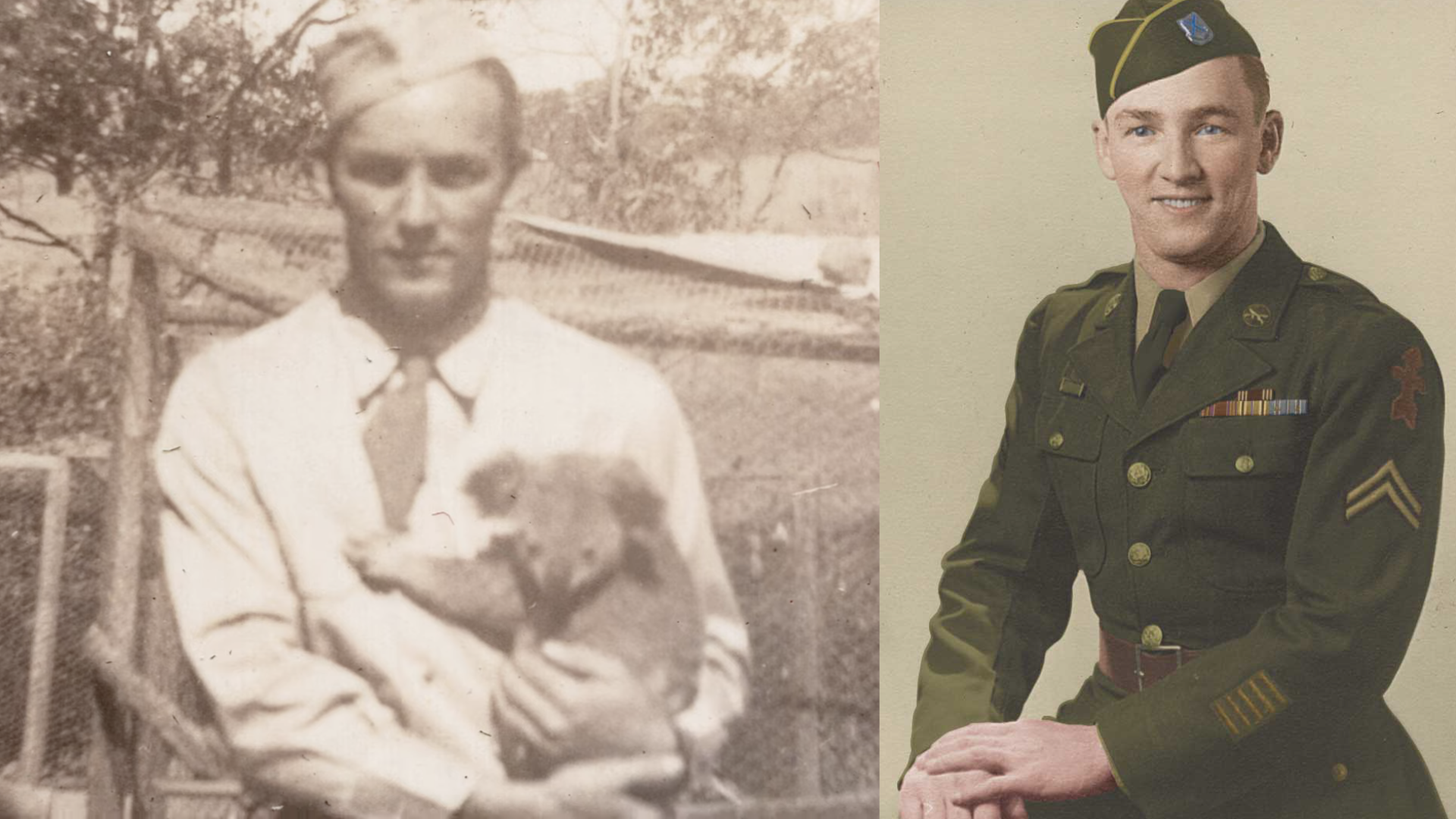
Carl Stenberg.
Donna Wilson’s grandfather, Carl Stenberg, fought in the New Guinea Campaign. His memories would play a significant role in James’s book, even if they remained mysterious to his own family members. “I saw a picture of him holding a koala in Australia,” Donna says. “And to me, that’s what he did during the war… he was in Australia holding a koala. It just wasn’t something that he or any of the men talked about.” The truth she discovered in the photographs and papers left behind by her grandfather, and in books like James’s, was beyond belief. In October 1942, a battalion of American soldiers spent 48 days climbing over a 10,000 foot mountain range, crossing near a peak called Ghost Mountain, through some of the wildest, most geologically-disturbed terrain on earth. The route they followed was known as the Kapa Kapa Trail. They arrived on the other side exhausted, starving, sickened with malaria, dysentery and typhus, to go into battle with the Japanese at a village called Buna, now converted into an impenetrable stronghold of bunkers and machine gun emplacements. For Donna, The Ghost Mountain Boys filled in many of the missing pieces of her grandfather Carl’s story. But she wanted to know more. As she sat beside him in hospice, she decided that she would hike the same trail he had taken all those years ago. She would climb Ghost Mountain.
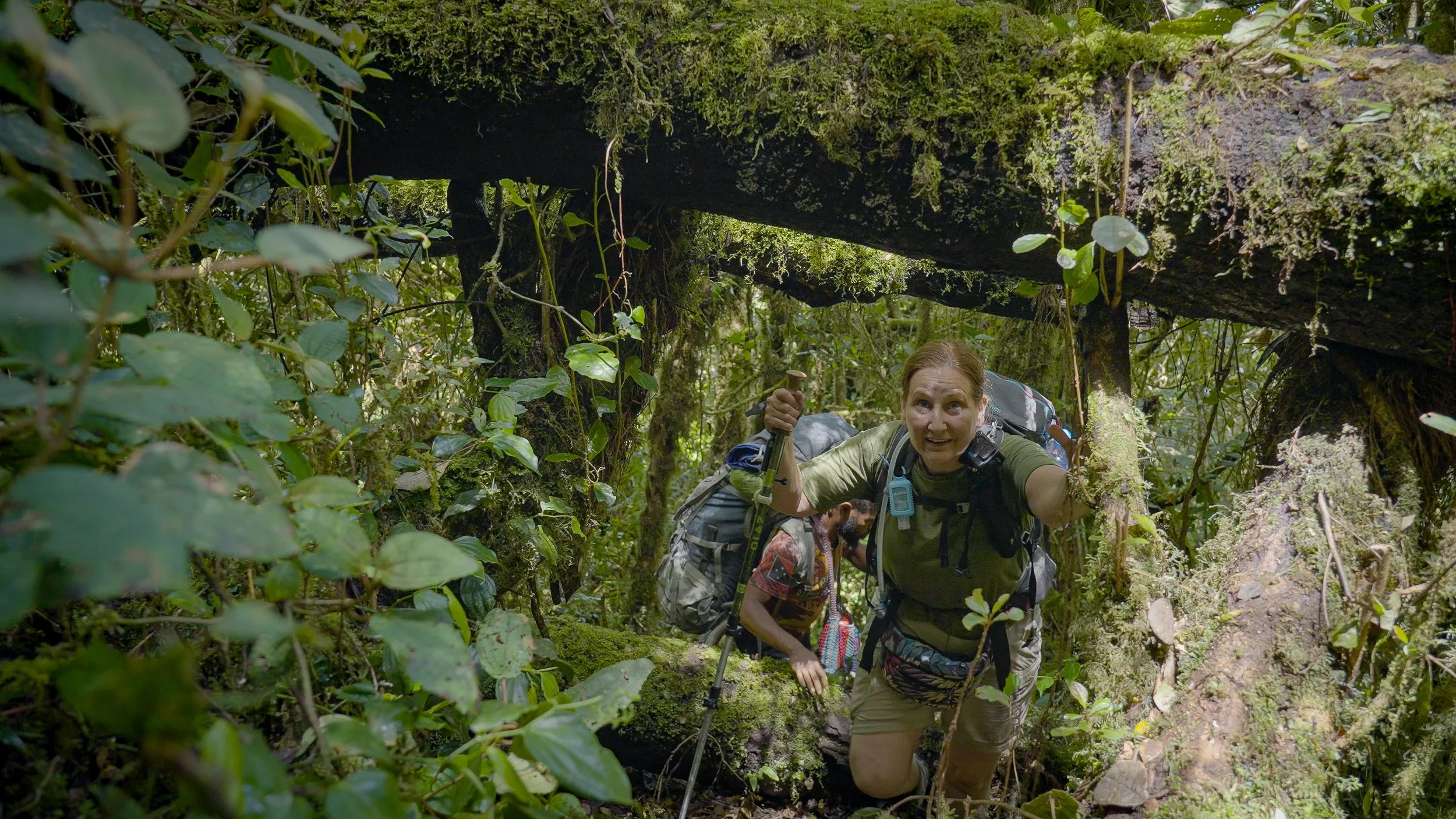
Donna climbs in the footsteps of the Ghost Mountain Boys, and her grandfather.
Years later, James’s book would find its way into the hands of a young pilot, Gary Bustin. Growing up an MK or missionary kid in the mountains of Goroka Province, on the north side of the Papua New Guinea, Gary was a luminous “waitskin'“ in a loincloth among his native friends. Early in his childhood the family moved down to Lae—of Amelia Earhart fame—where workers laying the new water and sewer lines dug up old WWII relics and piled them in the streets. “My buddies and I would play with the old rifles, we had metal hats and live grenades that were rusted… it really brought World War Two home to me as a kid.” For stories, they’d listen to a salty old man who lived on the beach and had been a “coast watcher” for the Allies, keeping watch day after day for Japanese ships. In a place where the world’s most devastating conflict turned its eye for three long, bloody years, history wasn’t just academic. At twenty one, Gary started a float plane operation to bring medical care and supplies to remote parts of the island. “I fell in love with the people of Papua New Guinea,” says Gary. “I decided I was going to dedicate my life to making a difference in this country.” And he never forgot about his love for history.
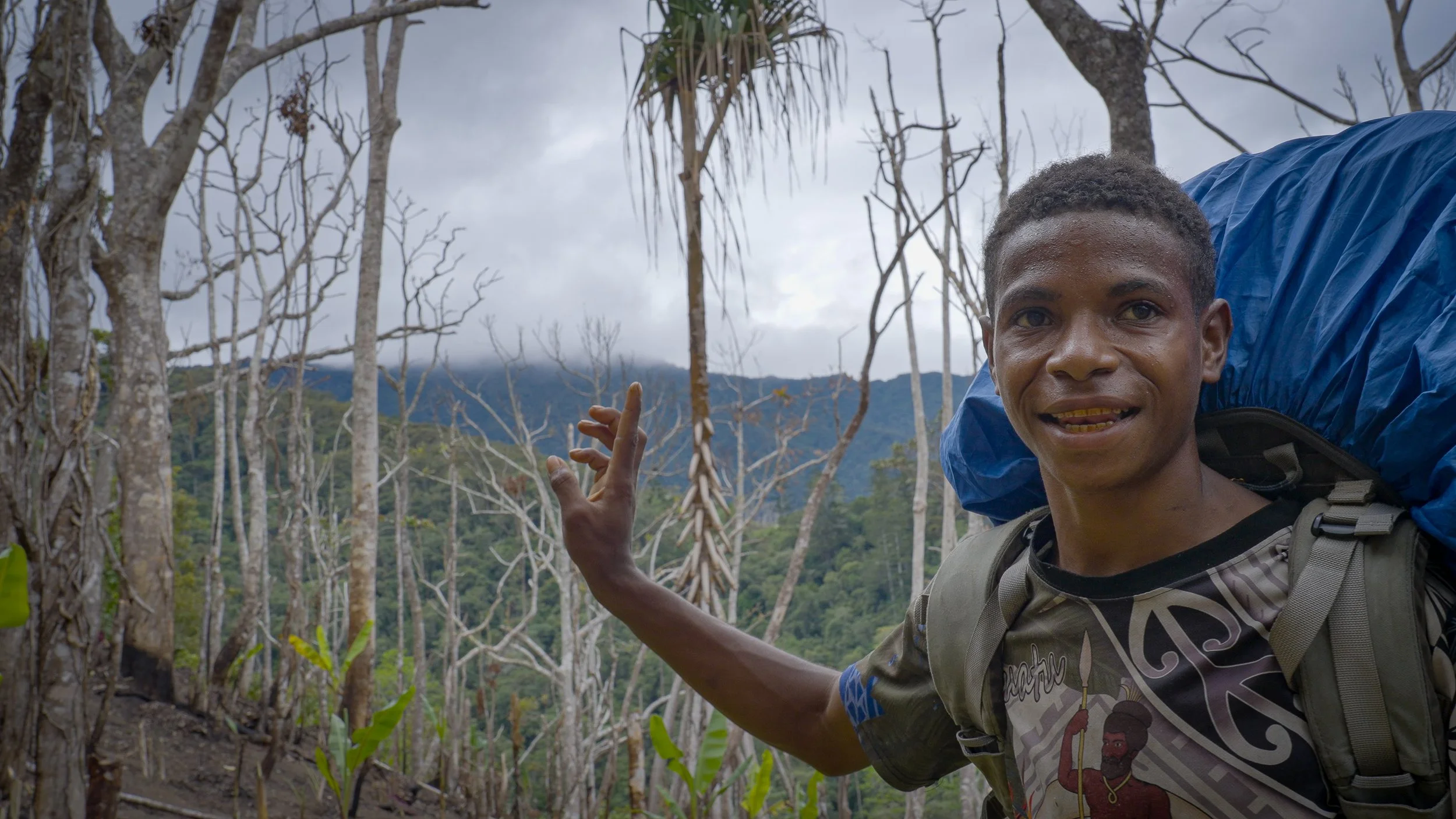
The forest is so thick that a view of the surrounding mountains is rare. In a patch of land cleared for gardens, Amu points to Ghost Mountain, obscured as usual by heavy clouds.
Thus, six years after that first phone call, I find myself, along with James, Donna, and Gary, as part of ten-member expedition headed deep into the Owen Stanley Mountains. We’re about six thousand feet above sea level, halfway up a muddy shark fin that plummets into emerald canopy on either side. I’ve got a camera in one hand and a tree root in the other as I pull myself up another few feet. Amu Amos, who these last three days has helped me carry my personal things and film gear, scampers ahead and looks back to check on me. Through trees, a pale snake of grassland and water marks the bottom of the Mimai River valley where we set out a few days ago. It’s the last, toughest climb before we camp at a high clearing that is the gateway to The Flying Dutchman, a C-47 Douglas Skytrain laying quiet in some moss-grown cathedral, where 17 soldiers—our countrymen—died in 1942.
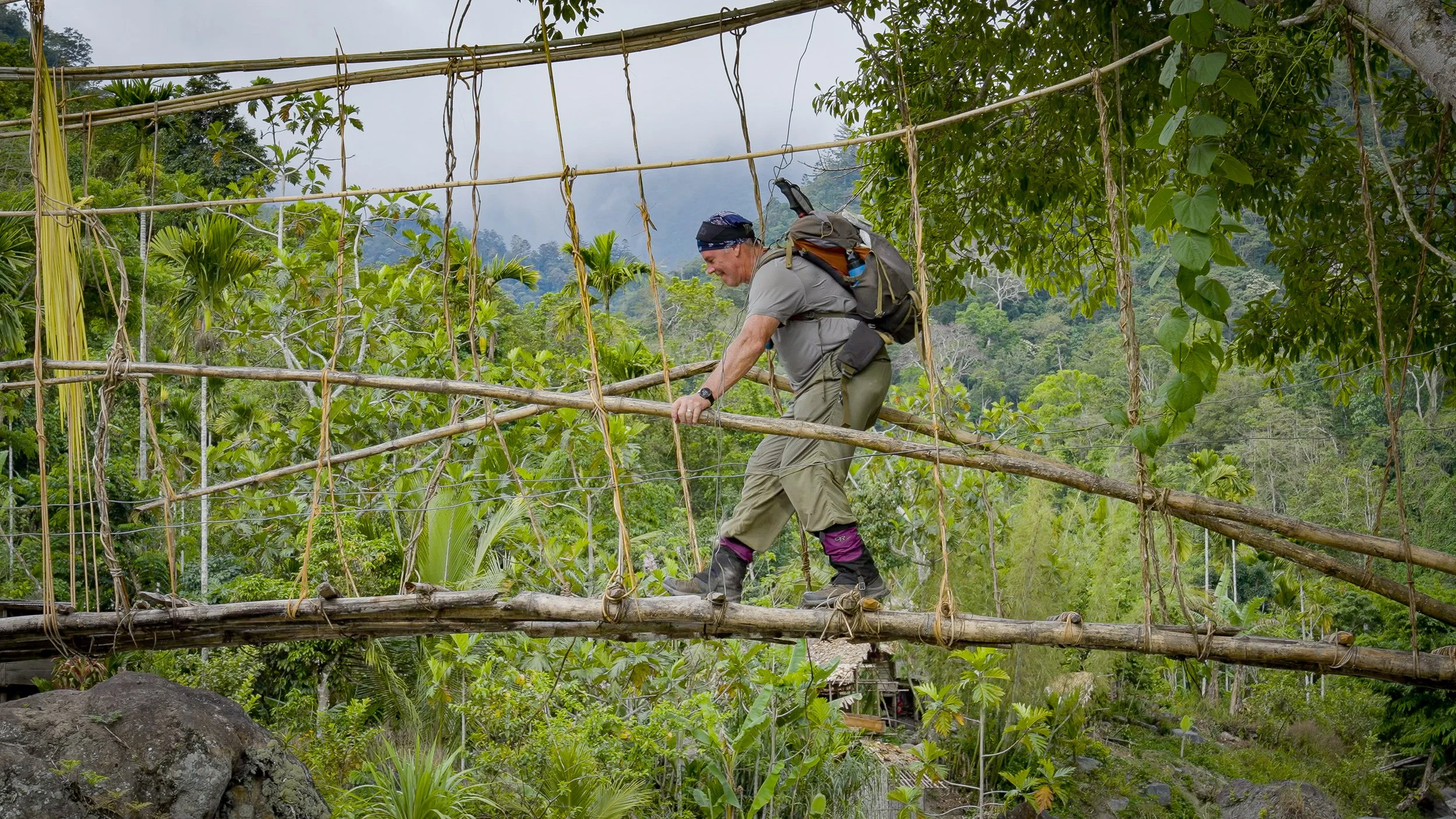
“Villagers still talk of the war. These war stories have become part of the local mythology, passed down by people from one generation to the next around the fire. Resentment lingers. The war destroyed villages and innocent people’s lives.”
—James Campbell, The Ghost Mountain Boys
Nothing But History
Waiting at the top of the ridge is Peter Gamgee, an Ozzie of few—if humorous —words. He wears his Getaway Trekking jersey, a backpack with GPS unit attached at the shoulder, shorts and spats over his boots to keep out leeches, chiggers and other creepy-crawlies of the forest here. A veteran of the Kokoda Trail—a kind of pilgrimage where Ozzies commemorate the Australian thwarting of the Japanese invasion of Port Moresby in 1942—Peter was initially drawn to the Kapa Kapa for the challenge it presented. "The Kokoda on steriods” was the popular refrain, for its length, remoteness and brutal elevation profile. In 2009, he and a handful of hikers tried to cross the country in 12 days, surely a record for Westerners at least. In short, he came for reasons of his own, and stayed for the people. He also has a fondness for puns.
One of those people, Kuname, confers with Peter before heading down the trail to camp. He’s our lead porter, a young man, recent father and part of a generation of villagers whose parents accompanied James and Peter on their first expeditions here. In the coming years, they will oversee their village’s’ continued transition into the modern world. Now, they oversee our party’s transition into camp: gathering wood for fire, boiling water, pulling tarps over beams they’ve lashed together with jungle fibers as the members of the expedition wander to a frigid stream to bathe and don warmer clothes. Dinner is spaghetti and prepackaged sauce, supplemented by soup and a true wonder of cuisine (to my American sensibilities), Wheetabix. It’s colder up here at 8,000 feet, the steam from after-dinner tea and Milo rising oracular as James and Peter launch into the story of the Flying Dutchman.

During a dramatization, a man speaks about the impact of the Second World War on his people. The sign reads, “Thunders, lightning strikes. My people lost… what am I?” Certainly a reference to planes, guns, bombs, and other powerful forms of mechanized death that descended on the island.
Starting in mid-October 1942, the men of the second battalion of the 126th Infantry marched across the island of New Guinea. Lacking proper supplies or training for the ordeal, they suffered through mud and malaria, through dysentery and exhaustion, through the gut-wrenching waning of hope that accompanies impossible endeavors. Yet they talked hopefully among themselves, as Donna notes, about how their unorthodox march might be remembered in history: a maneuver to rival Hannibal’s crossing the Alps or ____, in which a handful of American soldiers turned the tide in the battle against totalitarianism.
Things would turn out very differently. The final gut-punch came several weeks into the trip, when a missionary dislocated by the Japanese informed the Allied high command in Moresby of tenable airfields on the north side of the mountains. As it turned out, the remainder of the 126th Infantry would be flown over the mountains rather than hike. Looking with anything more than a squint, the Ghost Mountain Boys’ monumental trek and suffering was essentially unnecessary, the whim of Douglas MacArthur, who depending on which side of history you fell on, was merely bedeviled by fog of war, or an egomaniacal son of a bitch whose per whose personal quest for glory left little for the lives of his men. James fell in the latter camp, and beginning his book with MacArthur’s flight from the Phillippines.
Aerial routes across the mountains were not well-established. The trip became known as the “hump”. A summary of the weather logs during the time reads: “Torrential rains kept crude native trails over the Owen Stanley Mountains between Port Moresby and Buna impassable most of the time. Adverse weather, including dangerous thunderhead clouds to 40,000 feet over the mountains, frequently limited air transportation and bombing missions.” Nevertheless, planes began crossing the Owen Stanley Mountains en masse, ferrying troops and supplies in preparation for the battle at Buna. The Flying Dutchman was once such plane. On November 10, 1942, this Douglass C-47 Skytrain departed the airfield at Port Moresby, bound for Pongani airfield on the North Coast. The plane that left the aerodrome that day carried three crew members and twenty members of the 126th Infantry Regiment. According to an account written by First Sergeant Edward Holleman:
Next came the Flying Dutchman. Being of Holland descent myself, it sounded kind of homey to me and immediately I had full confidence in the pilot… This plane was equipped for paratroopers so we sat facing each other across the aisle, ten on each side. The plane’s radio operator sat on a plain old wooden house chair in the aisle. We all carried a full field pack with three days’ rations, three days’ emergency rations, full belts of ammunition, plus a couple of bandoliers and two to three hand grenades each… We immediately took off and soon were riding high over the dark foreboding jungles of New Guinea. There was some small talk amongst the men but all were quite serious for we realized that we were headed for the real thing... We had been flying for almost a half hour when suddenly we were caught in a down draft and the plane fell toward the earth. Someone who was looking out the window said, “Boy, that was close! We clipped off the tops of some trees.” It seemed we had survived the fall and were airborne but the next moment we crashed.
The crash threw men and their gear to the front of the plane. Fuel ignited while ammunition and grenades went off. In the chaos that followed, men kicked frantically at windows while Holleman managed to locate and open the side door. The survivors tumbled out, returning quickly to retrieve the wounded. Six had perished in the crash. The survivors huddled into the rear of the plane while fire burned the remainder of the front, and explosions rocked the forest while the surviving men shivered and looked up at the mist. What were they thinking then?
The next morning, we float out over a strange landscape, legs sore from three days of steady climbing, breath fogging in the cold. For me it’s a chimeric landscape: an unlikely fusion of tropical forest and the alpine tundras of the Rocky Mountains where I grew up: great spongy tufts of thin-stemmed grass, a quilt of oranges and pale greens, midget palm trees, giant spiderwebs a-glisten with dew drops. The final climb to The Flying Dutchman is some of the toughest yet, a steep mud-slick traverse through moss-grown forest.
Peter’s own story is fascinating. He worked on Over-The-Horizon radar during the Cold War, leading up a team that developed a system which was recently sold by the Australian government to Canada, to the tune of several billion dollars. He has, it seems, always been concerned with things in the sky. But his real passion, he tells me, is “the development of people.”
Donna’s a great example. In 2016, she arrived in New Guinea determined to hike the Ghost Mountain Trail, and never having done any serious hiking before. The first week was brutal. When they arrived at Laronu, the gateway to the mountains, Peter radioed for a helicopter. Donna expected that she would be on it, bound for Port Moresby and ashamed. But it was only for resupply. Instead of send her home, Peter suggested she hire a local to carry her gear. They still had a long way to go. Over the next few weeks, Donna found a strength she didn’t know she had, and which only comes from pushing oneself beyond one’s limits.
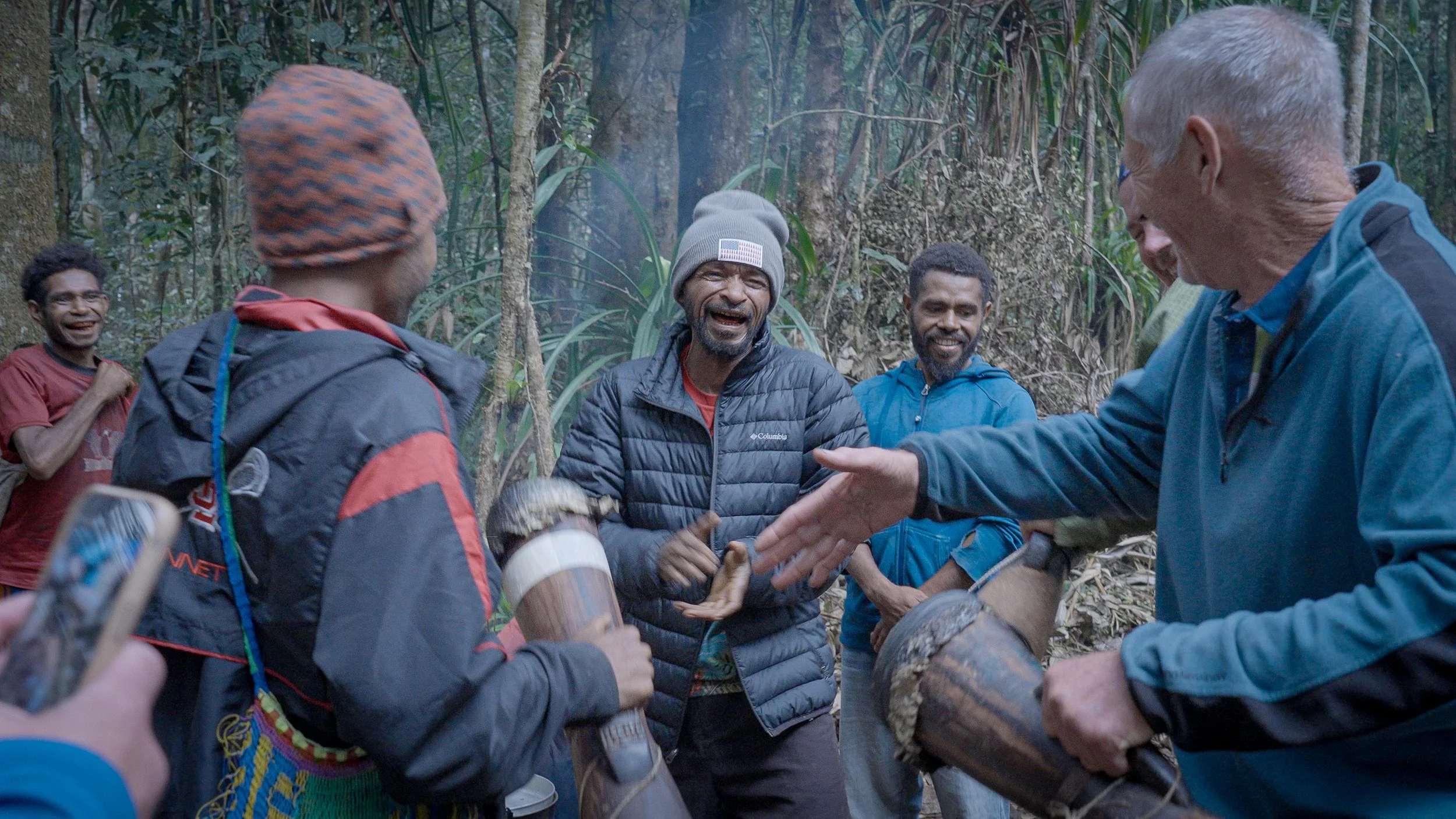
Peter and James have endeared themselves to the people of the Mimai River valley. They wrote them a song during our trip—a real honor, as the songs are part of their oral history tradition.
PARTNERS



The Flying Dutchman
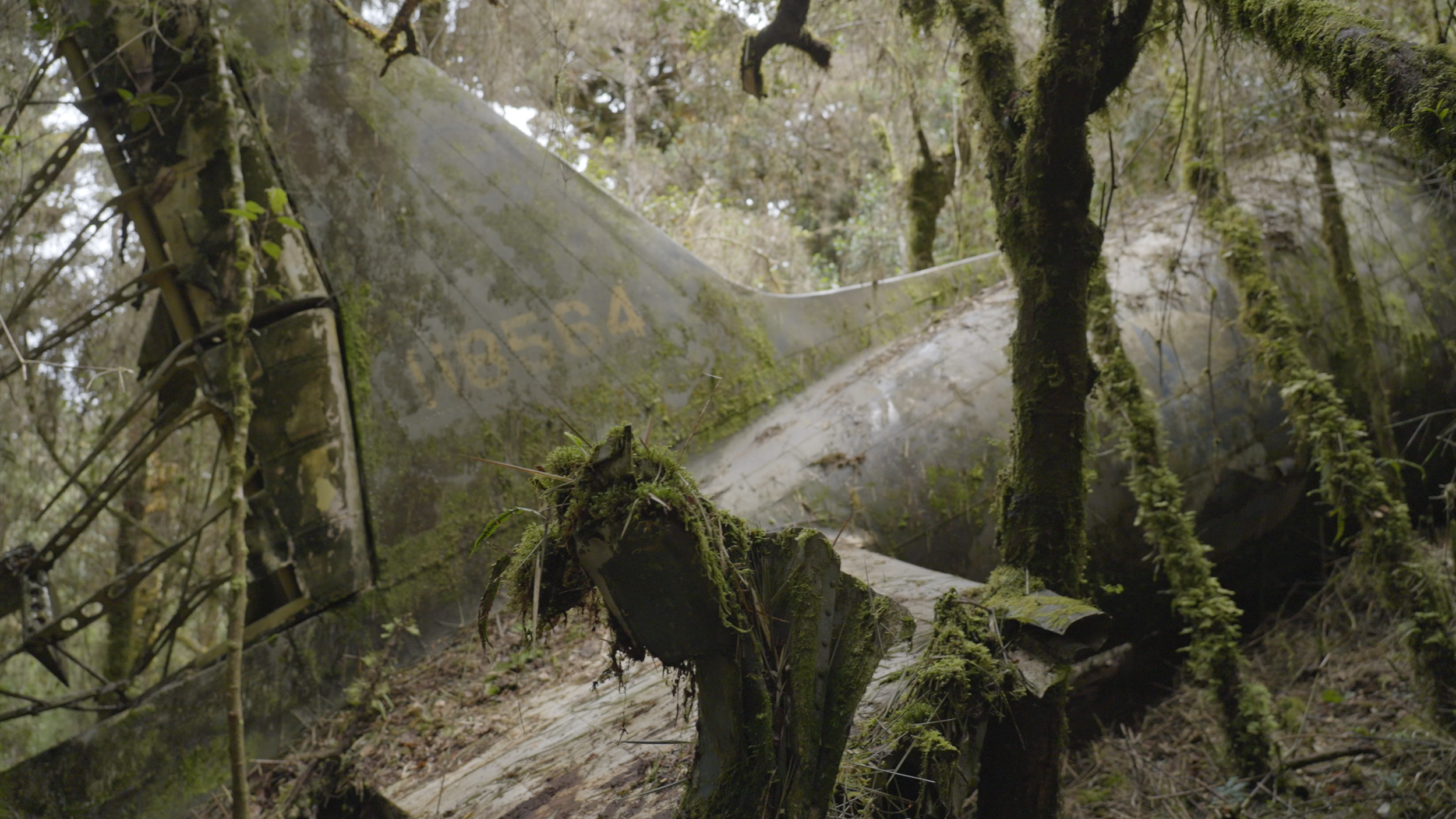
The Flying Dutchman lies above 9,000 feet, located in the moss forests below the summit of Ghost Mountain.
Having decided to pursue the plane, Peter began searching in earnest. His leads were like a noir detective corkboard. He had little information to go on: the account of government patrol officer who had visited the wreck in 1962; a manuscript by an Australian expat, Robert Piper, who had assisted in the rescue; Edward Holleman’s account; an interview with Bruce Hoy a former curator at the Papua New Guinea museum, who had visited the crash site with locals in 1988. But without GPS technology, the word “found” did not have any real meaning, there were no trails to the crash and no villages in the area, Hoy had flown in by helicopter while assisting the army on another crash recovery, and the locals who located the plane for him were perhaps no likely to be able to do so again… the word “found” didn’t really apply. Everyone who had “found” the plane had used local assistance. The plane vanished back into the forest. Through accounts of multiple sources, telemetry and lots of map-staring, he narrowed down the location to a site southeast of Mount Obree, or Ghost Mountain. We spoke in the Spring of 2025 and he told me he was almost positive, but there was no guarantee.
Already, the trail is better. Villagers have spent many hours cutting small trees, notching steps in logs, even laying logs where the trail has collapsed down the mountainside. It’s all part of the Ghost Mountain Expedition, and work for which they and their families will be paid. Still it’s a hard climbing. After a steep pitch, the ground levels slightly. We sidehill through the mossy trees, suddenly there our first piece of wreckage, a bit of the fuselage lying among the leaves. A few steps further and we see an old toolbox, standing upright, where Holleman and others started a fire to cook and keep warm. The hull of The Flying Dutchman lays like a broken. It’s miraculous, for the people of this river valley, for the
The previous fall, the window opened. Story of Peter finding the plane.
The plane lies broken on the slope, the front having been destroyed in the crash and by fire, the rear fuselage and two wings broken off and swallowed by moss and detritus. Immediately, two of the villagers begin cleaning the side of the plane, wiping the moss off.
Successor to the civilian DC-3, which at that time carried most of the civilian air traffic in the world, the DC-47 was a militarized version delivered to the US military in 1941, quickly becoming the workhorse of the Pacific. It was a versatile aircraft: it had two radial-pistoned Pratt & Whitney engines that could function with pistons down, and could transport men, material and had a modified tail allowing it to tow gliders.
To the visiting Westerner, their lives seem idyllic. But a chance scratch can fester in a tropical ulcer that steals limbs and life. Half the villagers have a cough. Villagers hitch a ride on the plane or walk into the capitol city. The only schoolhouse in the region, at Laronu, has over 150 students, and is taught by a man who doubles as a pastor. Too, as we pass through the village, we see solar panels. An iPad used to take pictures. James notices, “They are becoming aware of the modern world, and they want it,” His tone is a touch rueful, ambivalent. “Who wouldn’t?”
The trip was monumental in other regards. James was along, this time with his 15-year old daughter. The women and girls were entranced by Rachel. Her long, mostly straight hair, compared to theirs which was curly. The fact that she was undertaking such a long voyage with a group of men.
There were harder moments, when the seeming randomness of life shows us our blessing, and what we might give. Peter tells me later: In 2008, while passing through the village of Jaure, a woman came crawling out of her hut to meet him. She’d developed a tropical ulcer on her leg, likely from a simple scratch or insect bite, which had festered in the absence of simple things we take for granted: clean water, gauze pads and band-aids, neosporin. The smell was awful. “We were on the satellite phone with anyone, mining company to see if they could bring a helicopter in.” It was futile, they left everything they had: a cleaning regimen and antibiotics, but it was clear that she didn’t have a chance.
It was on the trip with James’s daughter that Peter and James were struck by a realization… the people of the Mimai River valley had nothing to offer the world in return… nothing, perhaps, except history. A history. And a very real piece of that history: The Flying Dutchman.
Thus began Peter’s search for the plane.
I’m reminded of a scene in a children’s book, the Chronicles of Narnia. The plane is the great lion Aslan, lying slain on the stone table. Suddenly, mice come out of the tall grass to chew away at the ropes binding him to the stone table. Our presence is trivial here, but also could set free some of the suffering. The plane may once have been the property of the US government, but now it belongs to the villagers of the Mimai River valley. For them it is a lifeline, the reason for the appearance of foreigners like James and Peter and Gary, and the one thing they can offer the world.
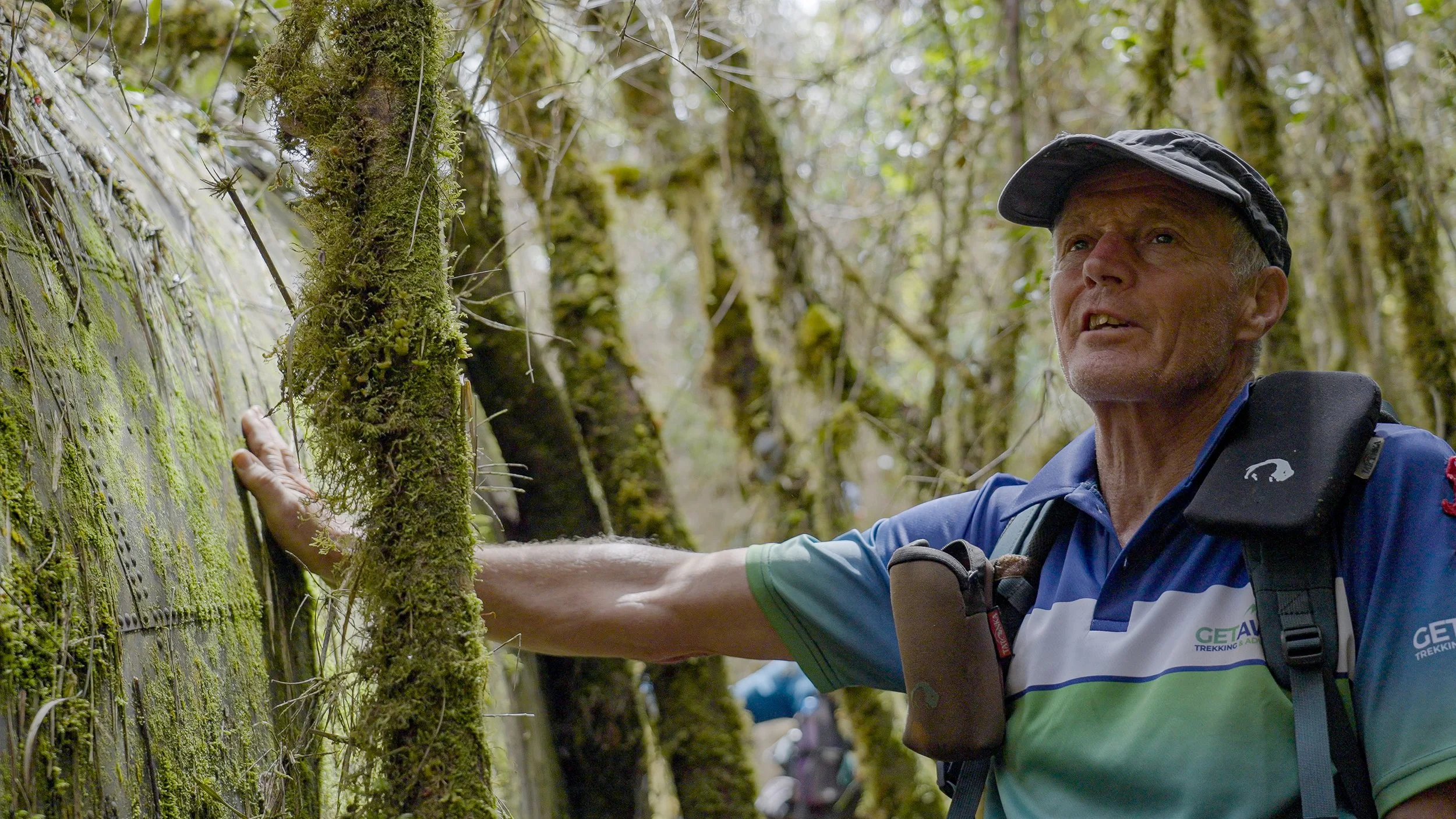
“I ended the trip with a conviction that the intention to help the communities along The Ghost Mountain Trail is absolutely the right thing to do.”
—Peter Gamgee, In Search of the Flying Dutchman
“Our Biggest Day”
The Flying Dutchman lies above 9,000 feet, located in the moss forests below the summit of Ghost Mountain.
Finally, our vector corresponds with those of the men of The Flying Dutchman.
On the fifth day, Edward Holleman led a group away from the plane. It was quite clear that rescue would not come. Their various efforts including building fires, floating balloons with urine, had failed. They walked for days through the jungle.
Gary breaks away from the group to make a satellite call. He’s been in close coordination with members of the government, and is cooking up a surprise delivery to Dorobisoro and a press junket. The idea is to launch the Ghost Mountain Expedition as a tourism project. His foundation, PNG Tribal, specializes in sorcery accusation related violence, which unfortunately now has its own acronym, SARV. But the Ghost Mountain project seems like a chance for him to indulge his love of history, and to make political in-roads.
There is some apprehension surrounding our return to Dorobisoro. A villager who wants to be a “Big Man” harangues the expedition on social media. The villagers of Dorobisoro have demanded a larger percentage for using the airstrip. The same kind of politicking and resource bickering that scales ad infinitum through the outer modern world. The politicians supporting the project, no doubt, have their own self-interested reasons for being involved. For a moment I’m reminded of the Ghost Mountain march, the great heroic toil for… what?
Mercilessly engineered videos that triumph greed and , and that perhaps most American of fantasies, that fuzzy thoughts and posturing will, like some invisible hand, magically unmake the awful world we are creating with our choices.
They arrived to find the chaplain, the last alive. He died while the villagers tried to feed him bananas. On the door to rear storage and lavatory, they found a diary with heartbreaking entries:
“This is our biggest day coming up,” said Ed Holleman on their fifteenth day. That day, they came upon a trail, clearly made by humans.
For James, the trip has been one memory after another. For a man whose life has blended with that of New Guinea for the last several decades… his honeymoon, hiking the Ghost Mountain trail several times, first for his book, then again, then with his fifteen year old daughter. Around every bend in the trail is a new memory waiting to catch him by surprise. “You’ll see,” he tells me. “You’ll get back home. You’ll smell something, see something, and say, that reminds me of New Guinea. It’s part of who you are.”
In the months that follow, tragedy will strike the villages of the Mimai. On our group WhatsApp, Peter informs us that one of the carriers died. For a moment I’m terrified, remembering Amu and his cough. Two months later, we get knews that another died, probably from malaria. What is the point of trying beat.
Peter is headed back in May to install solar panels and lighting in the medical clinic and, pending the government’s acceptance of Starlink for which Gary and his organization are working, a communication system. I include it here verbatim (or the WhatsApp equivalent of that):
In case you hadn't seen the news - the village you flew in to Dorbisoro and now a little less ..soro.. because it has power, light and StarLink at the run-down medical centre! And now nearly 150 children vaccinated and 5 pregnant ladies - to mention just a little.... It also has a vaccination fridge - so they can continue to vaccinate as people come in from the surrounding area. And two new Health Workers - both good value from what we experienced. The journey everyone took to Flying Dutchman has helped in a way to realise this achievement - Stage1 of the plan…

Kuname and Didibu help Gary cross a river in the village of Laronu. As Gary said in his interview with me, “They welcomed us into their world… we each have something to offer the other.”
Peter finishes his interview with the story. Two years after passing through Jare, he returned with a group of hikers. He was worried: recalling how he’d treated Pamela, there was no way she could’ve survived. Planning an expedition like this is an endeavor of great complexity, and he had to take in all possibilities. All land in the valley is owned by the people, so of course you need the people’s permission to walk along the trail. If something bad happens, it is not uncommon for people to hold resentment toward those who are involved. Curses, evil spirits and such. “I wasn’t sure if we’d be speared,” says Peter.
“How’s Pamela?” he asked fearfully. Pamela? someone said, “Pamela’s fine. She’s out in the gardens.” Peter pauses here, tears coming even all these years later.“We couldn’t believe it,” said Peter. “We went up there. We just melted.”
No rest for the weary. Upon arriving back in the capital, Gary and PNG Tribal organized a press junket at the National Museum. I stayed up all night looking through footage and cut this teaser together for the event… what an experience!